
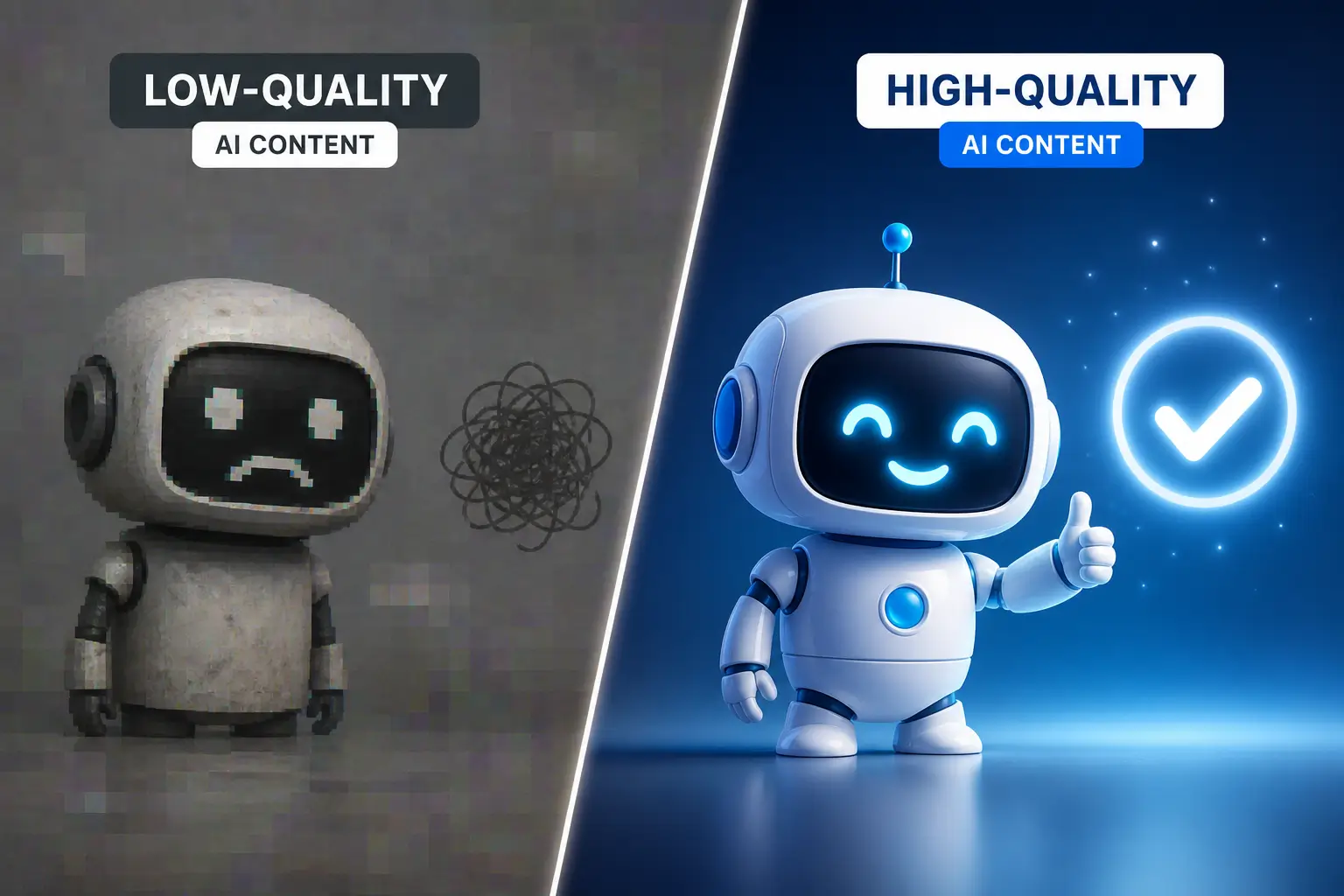
AI has made content creation faster—but not better by default.
Today, many brands are publishing AI-generated content at scale. The problem? A large portion of it is low-quality, generic, and ineffective—which not only fails to rank but can also damage credibility.
Search platforms like Google and AI tools such as ChatGPT are now better at identifying content that lacks real value.
The result:
👉 Low-quality AI content gets ignored
👉 High-quality, experience-driven content gets rewarded
Let’s break down how to spot the difference—and fix it.
What Is Low-Quality AI Content?
Low-quality AI content is not about AI itself—it’s about how it’s used.
It typically:
- Repeats common information
- Lacks depth or originality
- Doesn’t solve a real problem
- Feels generic and interchangeable
In simple terms:
If your content could apply to any company in any industry, it’s probably low quality.
5 Clear Signs of Low-Quality AI Content
1. Generic, Surface-Level Writing
It explains “what” but not “how” or “why”.
Example:
“Industrial safety is important for protecting workers and equipment.”
👉 This adds no value. It’s obvious and unhelpful.
2. No Real-World Context
There are no examples, use cases, or practical applications.
Weak:
“Monitoring systems help improve safety.”
Strong:
“Continuous gas monitoring in anaerobic digesters helps detect methane build-up early, reducing explosion risk in confined environments.”
3. Repetitive Language and Structure
AI often repeats phrases or ideas in slightly different ways.
Signs:
- Same sentence structure repeated
- Overuse of keywords
- Filler phrases like “in today’s world,” “it is important to note”
4. No Unique Insight or Perspective
The content doesn’t reflect:
- Industry knowledge
- Experience
- Brand positioning
👉 It feels like it was generated for volume, not value
5. No Clear Audience Focus
Low-quality content tries to speak to everyone—and ends up helping no one.
Example: Low-Quality vs High-Quality AI Content
❌ Low-Quality Version
Industrial monitoring systems are important for improving safety and efficiency. These systems help companies track performance and reduce risks. Businesses should invest in modern solutions to stay competitive.
✅ High-Quality Version (Improved)
In biogas facilities, gas accumulation inside anaerobic digesters can create hazardous conditions if not monitored continuously. Fixed gas detection systems provide real-time visibility into methane and hydrogen sulfide levels, allowing operators to respond before thresholds are exceeded.
This is especially critical in enclosed or unmanned sites, where delayed detection can lead to safety incidents or compliance failures.
What Changed?
- Added specific industry context (biogas, digesters)
- Introduced real risk (gas accumulation)
- Explained how the solution works
- Made it relevant to a defined audience
How to Fix Low-Quality AI Content
1. Add Real Expertise
Ask:
- What would an engineer or expert actually say?
- What details are missing?
👉 Include:
- Technical specifics
- Standards (ATEX, DSEAR, IECEx)
- Real use cases
2. Make It Problem-Solution Driven
Instead of:
“Monitoring systems are useful”
Write:
- What problem exists?
- Why does it matter?
- How does the solution solve it?
3. Use Specific Examples
Examples instantly increase quality.
Add:
- Industry scenarios
- Product applications
- Real-world conditions
4. Remove Fluff and Filler
Delete:
- “In today’s fast-paced world…”
- “It is important to note…”
Replace with:
- Direct, clear statements
5. Align Content with Your Brand
For B2B/industrial brands:
- Focus on precision, clarity, and credibility
- Reflect your engineering or technical authority
Quick Checklist Before Publishing
Ask yourself:
- Does this content solve a real problem?
- Is it specific to my industry?
- Does it include real-world context?
- Would an expert find this useful?
- Does it sound like us, not just AI?
If the answer is “no” to any of these—revise it.
Conclusion
AI is a powerful tool—but it doesn’t replace expertise.
Low-quality AI content is easy to produce, but it rarely performs. High-quality content, on the other hand, requires:
- Context
- Insight
- Intent
In today’s SEO landscape, success doesn’t come from publishing more—it comes from publishing better.